

Equity data security toolkit and checklist.
Find the sensitive data your equity plans hold, check where your team relies on manual or person-dependent practices, and turn the biggest risks into a 90-day plan.
- 7
- Pages
- 11
- Data types
- 5
- Risk areas
- 90
- Day roadmap
From the global equity experts at Allshares, working with 1,500+ companies in 110+ countries.
 7 pages, PDF
Get the toolkit
What's inside
Audit the data. Then plan the fixes.
The toolkit starts with what you store and where the risk sits. Then it covers team training and the questions to ask vendors, and ends on a roadmap that turns your three highest risks into next steps over 90 days.
Start here
Audit your data and your risk
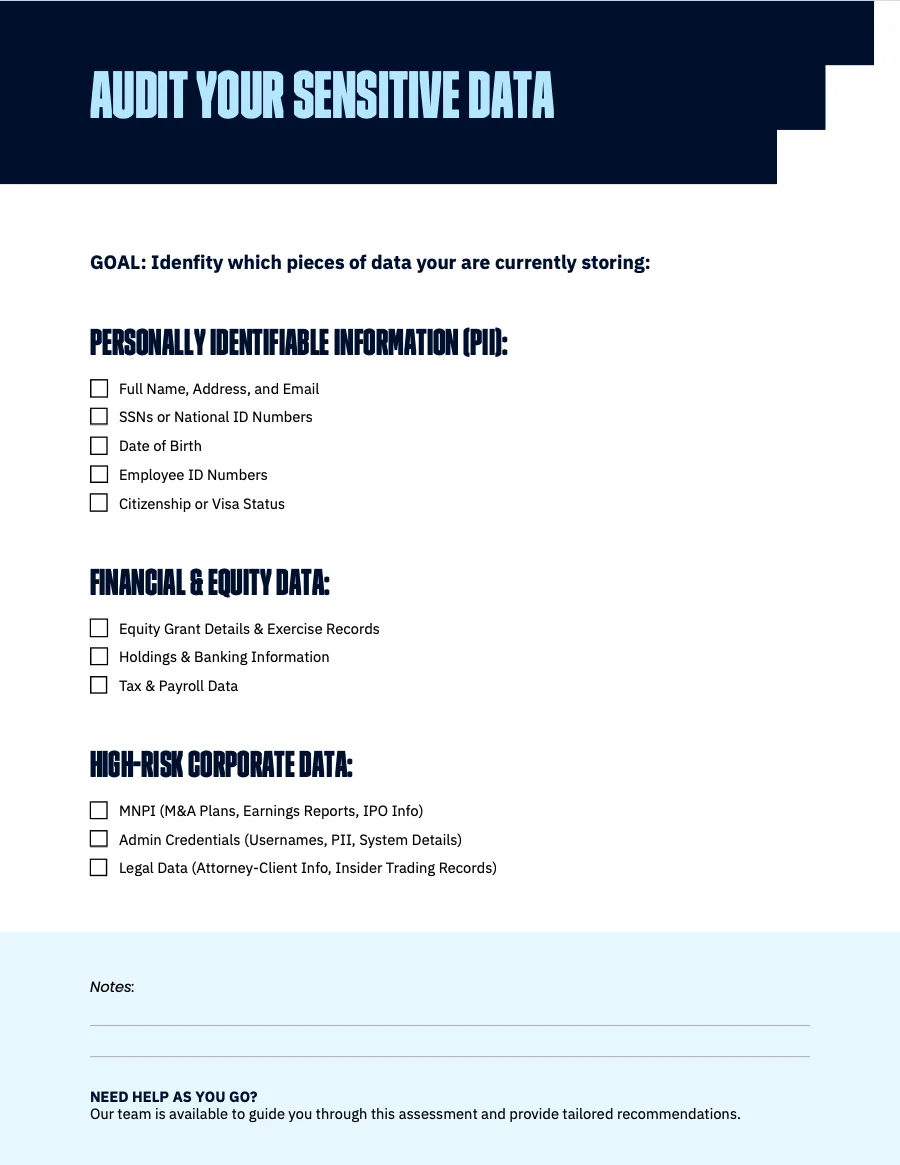
List the sensitive data you store in three groups: personally identifiable information, financial and equity data, and high-risk corporate data such as MNPI and admin credentials. Then check five areas where your team relies on manual or person-dependent practices, and write down the details of each.
- Data types to check
- 11
- Risk areas
- 5
Pages 3 and 4
Then act on it
Training, vendors, and a 90-day plan
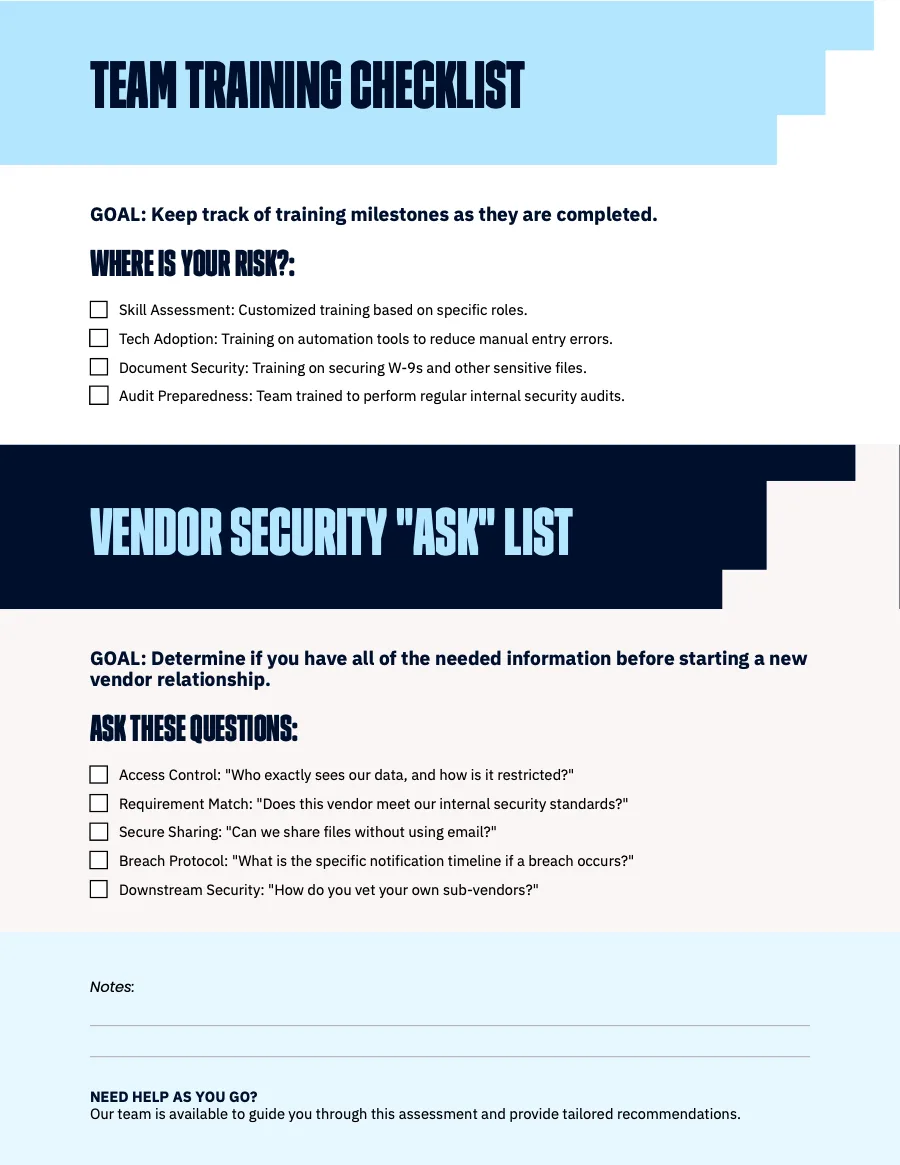
Track four training milestones with your team and put five questions to a vendor before the relationship starts. Then rank your three highest risks and work them over 90 days: the critical gap first, training next, and formal vendor reviews last.
- Training milestones
- 4
- Vendor questions
- 5
- Roadmap
- 90 days
Pages 5 and 6
From the toolkit
Five risk areas to check.
The risk area diagnostic looks for places where your team relies on manual or person-dependent practices. Tap each area that applies to you.
0of 5 apply to us
Tap a risk area to count it. Your answers stay on this page.
Who it's for
Written for teams that hold equity data.
It's for stock plan administrators and the HR, finance, and legal teams who handle equity data: participant ID numbers and banking details, grant and exercise records, and material nonpublic information (MNPI).
Work through it one section at a time, note issues as you go, and flag the areas that need a deeper review. It's a framework for your team, and it isn't a security audit or legal advice.
Weighing how a provider handles your data? Read our Trust Center
Get the toolkit
Common questions
Equity data security questions.
What counts as sensitive data in equity administration?
The toolkit sorts it into three groups. Personally identifiable information: full name, address, and email, SSNs or national ID numbers, date of birth, employee ID numbers, and citizenship or visa status. Financial and equity data: grant details and exercise records, holdings and banking information, and tax and payroll data. High-risk corporate data: MNPI such as M&A plans, earnings reports, and IPO information, admin credentials, and legal data such as attorney-client information and insider trading records.
What should you ask an equity vendor about data security?
The toolkit's vendor ask list has five questions for before a new vendor relationship starts. Who exactly sees your data, and how is access restricted? Does the vendor meet your internal security standards? Can you share files without using email? What is the notification timeline if a breach occurs? And how does the vendor vet its own sub-vendors? Vendor selection best practices
How do I turn the findings into a plan?
The last page asks for your three highest risks, then sets a 90-day timeline. Days 1 to 30 fix the most critical gap. Days 31 to 60 complete a training milestone with your team. Days 61 to 90 formalize vendor reviews with the vendor ask list.
Is the toolkit a security audit or legal advice?
No. It's a framework to work through with your team. For a security assessment, or for legal questions about the data you hold, talk to your security, privacy, or legal advisers.
 Articles
Data Security Retains Top Talent and Clients
Equity teams handle sensitive employee, financial and ownership data. Strong security protects that data and builds the trust that helps retain talent and clients. Here are the risks to guard against and the practices that reduce them.
Read Articles
Vendor Selection Best Practices
Choosing an equity compensation vendor decides how much operational load the team carries afterwards. This is a practical guide to running the selection, from requirements through to a partnership that holds up.
Read Articles
3 Key Risks in Stock Plan Departments
Three risks recur in stock plan departments: sudden loss of the administrator, no documented coverage, and dependency on one person's knowledge. This looks at how each surfaces and what reduces the exposure.
Read